The aisles of supermarkets and the displays of pastry chefs change their appearance with each season. Between reformulated recipes to contain less sugar, desserts that play with unexpected textures, and ice creams with unusual flavors, the gourmet landscape of recent months deserves our attention. Here are the sweet innovations that are reshaping our habits, along with the behind-the-scenes of a sector in full transformation.
New Nutri-Score and sweet desserts: what really changes on the shelves
You may have noticed that two packages of the same biscuit display different Nutri-Scores in the supermarket. This is not a labeling error. Since a French decree on March 16, 2025, the calculation of the Nutri-Score penalizes sugar more heavily: the maximum number of penalty points for sugars has increased from 10 to 15.
Manufacturers have until March 2027 to adapt their packaging. The concrete result: the old and new calculations coexist on the same shelves. A dessert rated B under the old system can drop to C or D with the new one, without its recipe changing by a gram.
Displaying the score remains voluntary. An attempt to make it mandatory, adopted by the National Assembly on November 7, 2025, was rejected by the Senate and then definitively dismissed in early December 2025. By following the news from Gourmandises et Bavardages, we see how much this topic stirs both sweet professionals and curious consumers.
For fans of industrial pastry, the consequence is direct: reading the ingredient list becomes more useful than relying on the colored label, as long as both versions coexist.

Reformulation of sweet recipes in mass distribution
Private label brands are not just waiting for the Nutri-Score transition. They are actively reformulating their sweet products. Carrefour committed as early as 2022 to remove 2,600 tons of sugar and 250 tons of salt from its private label products by 2026.
This movement goes beyond simple marketing display. It affects biscuits, dessert creams, breakfast cereals, and jams. Less added sugar does not mean less taste: formulators are using fruits, spices, or fermentation to compensate.
Controversial ingredients in the crosshairs
Beyond sugar, mass distribution is also targeting artificial colorants and certain additives. When a fruit yogurt switches from a synthetic colorant to a beet extract, the color changes slightly. The taste does too, sometimes.
This wave of reformulation creates a playground for artisanal brands that were already working with simple ingredients. They can now highlight an argument that was long considered secondary: the short ingredient list.
Ice creams and frozen desserts: flavors that shake up the classics
The ice cream aisle remains one of the most dynamic in supermarkets. Among recent launches, the Extreme cones have introduced two new recipes: Peanut & Caramel and Blueberry Cheesecake, sold for around 3.60 euros per box. These combinations move away from the vanilla-chocolate-strawberry triptych that has dominated the market for decades.
Textures are now as important as flavors. A cone that layers a crunchy layer, a melting heart, and a flowing topping tells a story in the mouth. This is what manufacturers call the multisensory experience, a term borrowed from restaurant pastry.
Why cheesecake dominates new ice cream flavors
Cheesecake, in all its forms, is establishing itself as the trendy flavor. It can be found in cones, bars, and tubs. Its profile (tangy, creamy, slightly salty) lends itself well to freezing without losing its aromatic complexity.
Artisanal pastry: fruits, terroir, and less sweet desserts
On the artisan side, the most marked trend is the return to seasonal fruits as the main ingredient, rather than just decoration. A dessert built around a mirabelle plum compote or a fig confit relies on the quality of the fruit, not on a massive dose of sugar.
Pastry chefs working this way apply a simple principle: sugar supports the fruit instead of masking it. The amount of added sugar decreases, while the sweet perception remains thanks to the ripeness of the fruit.
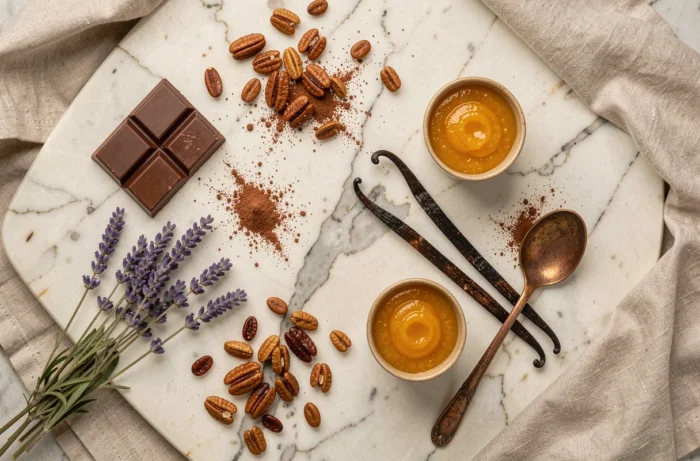
- Citrus fruits (yuzu, kaffir lime, bergamot) provide acidity and allow for reduced sugar without creating a sense of lack.
- Nuts (Piedmont hazelnuts, almonds, pistachios) add fat and texture, which compensates for the reduction of sugar in the mouth.
- Sweet spices (Bourbon vanilla, Ceylon cinnamon, tonka bean) enhance the sense of indulgence without affecting the sugar content.
This work on taste balance requires superior technical mastery. Reducing sugar in a biscuit alters its texture, shelf life, and color during baking. Every gram removed requires an adjustment.
Sweet products and transparency: how to read a food label
With the coexistence of two Nutri-Scores and the multiplication of claims (“less sweet,” “no added sugars,” “lightened”), knowing how to read a label has never been more useful.
- “No added sugars” does not mean “sugar-free”: the product may contain naturally occurring sugars from fruits or milk.
- “Reduced in sugars” implies a reduction of at least a quarter compared to the reference product, but the result can still be very sweet.
- The “of which sugars” line in the nutritional table remains the most reliable reference for comparing two products.
Comparing values per 100 g (and not per serving, which varies from one brand to another) gives an accurate picture. A dessert with 12 g of sugar per 100 g and another with 22 g tell two very different stories, even if their packaging looks similar.
The coming months will likely see more launches playing the transparency card. With regulatory pressure on the Nutri-Score, the reformulation of recipes in mass distribution, and the work of artisans on less sweet but more flavorful desserts, the French sweet landscape is transforming at an unprecedented pace. It remains to taste to form an opinion.