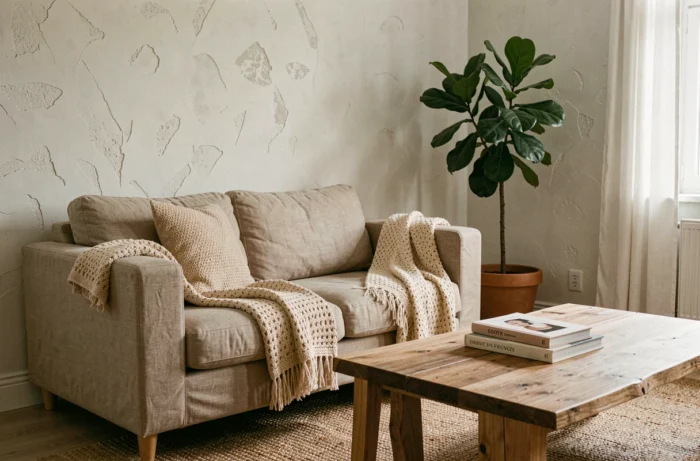
A load-bearing wall that can’t be knocked down, a narrow entryway with no closet, a north-facing living room that lacks natural light: most decorating projects start with a constraint.
Building a cohesive layout around these practical limitations delivers more lasting results than imposing a style seen online on a space that doesn’t suit it. Here’s how to turn your home’s quirks into assets, with choices of materials, colors, and furniture that stand the test of time.
Materials and colors: tailor your palette to the actual light in each room
We often choose a shade from a color chart or screen without considering the room’s orientation. Pure white on a north-facing wall looks gray and cold by the afternoon. A warm ochre in a south-facing room becomes overpowering in summer. Testing the color in place for 48 hours is the only reliable way to avoid having to repaint.
For rooms with little natural light, warm neutral shades (linen, sand, light terracotta) reflect light better than stark white. You can also link your choice of materials to thermal comfort: if insulation work is planned, factoring the wall finish (lime plaster, wood paneling, breathable paint) into the overall plan avoids doing the same wall twice.
Since January 1, 2025, homes rated G on the DPE no longer meet the decency standard for new leases, with ratings F and E set to follow in 2028 and 2034, respectively. Considering decor and energy efficiency together, rather than separately, saves time and money.
You’ll find ideas on Revue de Liberée’s home section for bringing these decorating choices in line with a home’s technical constraints.

Sustainable furniture and reuse: pieces with a story to tell
The usual approach is to furnish a room in one order, often from the same store, to create a coordinated look. The result is polished but impersonal. Mixing new pieces with secondhand furniture creates a character that a matching set can’t replicate.
Reuse and the social and solidarity economy
France’s reuse sector is now supported by specialist organizations and social and solidarity economy businesses. Reuse centers, community workshops, and dedicated platforms offer inspected furniture, sometimes restored. You can find distinctive pieces there (1960s sideboards, workshop chairs, farmhouse tables) at prices well below those of new furniture.
Repairability and disassembly as selection criteria
For an interior that may need to adapt (a move, a new baby, switching to remote work), choosing furniture that can be taken apart and has replaceable parts makes repairs, transport, and future reuse easier. Before buying, check three practical points:
- Can the legs and tops be separated with a standard tool, or is the piece glued and stapled together as one unit?
- Are wear parts (hinges, drawer runners, foot caps) standard items available at hardware stores?
- Can the finish (seat fabric, laminate top) be replaced without throwing away the frame?
A piece of furniture that meets all three criteria will last through several interior layouts.
Zone-based layouts: organize your space around your daily routines
Competitors talk a lot about style and less about how a space is used. We live in a living room, not a mood board. The first question to ask isn’t “what style do I want?” but “what activities take place in this room, and when?”
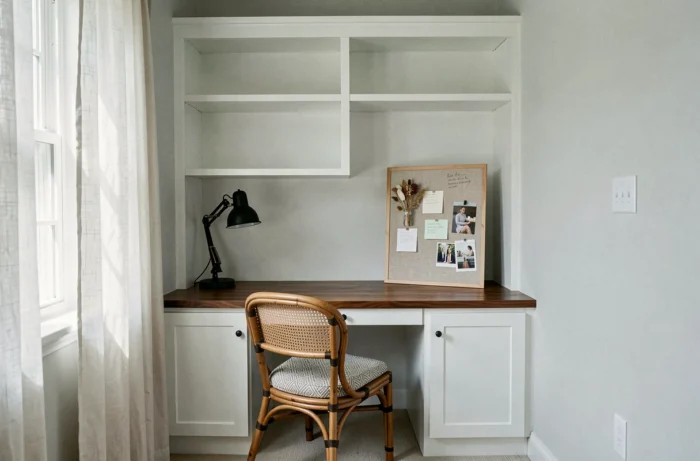
A living room that also serves as an office needs clear zoning: seating facing the relaxation area, a work surface with its back to the sofa, and separate lighting for each zone. No partition needed. A rug, a different light fixture, or a simple low shelf is enough to mark the divide.
Small spaces and biophilic design
Biophilic design (bringing natural elements into the home) doesn’t necessarily mean a living wall or an indoor greenhouse. In a small home, a few plants placed out of the way, a raw material such as unfinished wood or stone, and a view of the outdoors bring the idea to life in a practical way. The goal is to connect each zone with a feeling: natural light in the work area, soft textures in the relaxation area.
Personal objects and wall art: add character without clutter
Filling your home with decor bought in sets makes it decorated, not personal. Five thoughtfully chosen objects make more of an impact than a packed shelf. Postcards brought back from a trip, pottery by a local artisan, a framed exhibition poster: these are the details that give a room its own story.
For wall art, here’s a practical rule: hang the center of a frame or arrangement at eye level (about five feet from the floor). A group of frames works better when aligned along a shared axis (the bottom edge or centerline) than when scattered at random.
When it comes to textiles, cushions, throws, and curtains add character at a low cost. You can change a cushion cover each season without replacing your furniture. Varying textures rather than colors avoids a patchwork effect: raw linen, bouclé wool, and washed cotton in the same color palette add depth without visual clutter.
- Limit accent colors to two or three in each room to maintain an overall sense of cohesion
- Group small objects on a tray or console instead of scattering them across every surface
- Leave at least one wall or surface completely clear: empty space lets the room breathe
A home that feels like you isn’t a fixed project. The most successful spaces evolve through small changes, as you find new pieces and your life changes, rather than through a complete overhaul every five years.