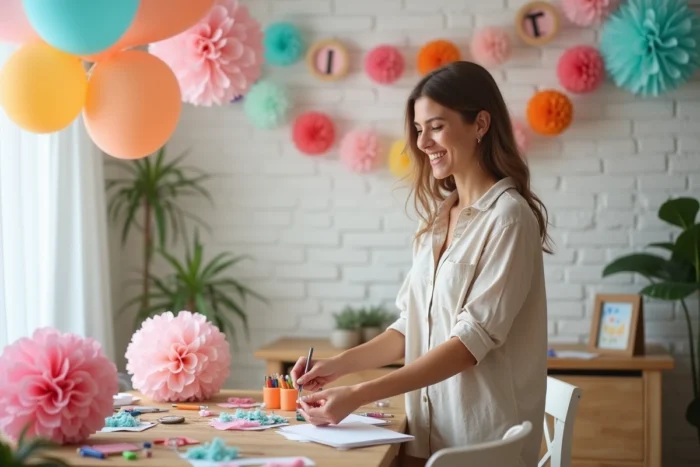
When preparing a birthday party for a 4 or 5-year-old in a 20 m² living room, you quickly end up with garlands hanging in the way, balloons blocking the door, and a table taking up half the space. Children’s birthday decoration is not just about accumulating accessories: it is primarily a matter of physical constraints, circulation, and safety.
Capacity and circulation: the constraint that no one decorates for
Before ordering any balloons, we count the heads. Since a decree in February 2026 regarding establishments receiving the public in an event context, small rooms rented for private parties are subject to a maximum capacity of 19 people present simultaneously, including children and adults.
Even at home, this flow logic applies. We identify three zones: the entrance (welcome, shoes, gifts), the play or activity area, and the table corner for snacks. Each zone must remain clear so that children can move around without knocking over the decorations.
In practice, we avoid balloon arches in narrow hallways and fix garlands high up, out of reach of little hands. If renting a room, we check the capacity before confirming the guest list, even if it means organizing the party in two time slots. To compare decoration offers suited to these constraints, one can consult the reviews on Annikids birthday that detail kits by age group and party format.
Color palette and birthday theme: limit to decorate better
We’ve all been tempted to buy a pink unicorn pack, then add green dinosaur plates because the child changed their mind the day before. The result looks like a toy store, not a party.
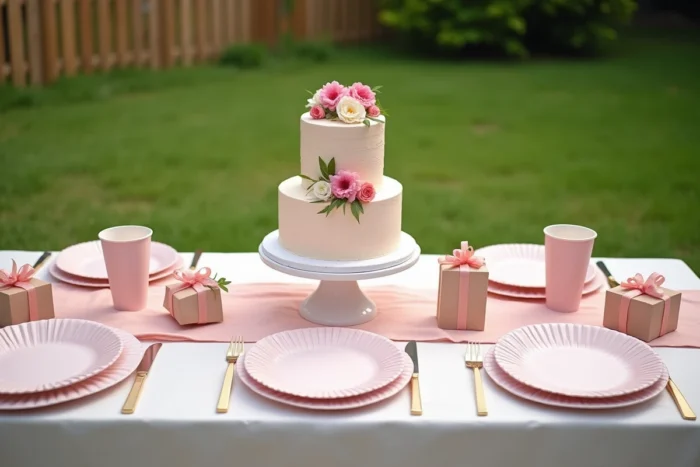
Three colors maximum are enough for a harmonious result. We choose a dominant color (the theme color), a complementary color, and a neutral (white, kraft, gold). This rule applies equally to a savanna theme as to a space theme.
Immersive theme or free palette
An immersive theme (pirates, princesses, superheroes) imposes its visuals on the tableware, tablecloth, and balloons. The advantage: everything coordinates easily. The downside: costs rise quickly if you want officially licensed items.
A free palette, without characters, often costs less. We buy solid color tableware, matching balloons, and make a few elements ourselves. Feedback varies on this point: some parents find the result more elegant, while others regret the absence of the child’s favorite character.
- Immersive theme: tableware, balloons, and tablecloth matching the character, little room for customization but guaranteed effect with the kids
- Color palette: coordinated solid color tableware, DIY elements (paper garlands, bunting), more controlled budget
- Mix of both: we choose one or two licensed elements (the cake, the napkins) and complete with neutral items to avoid overcrowding
Birthday table decoration: the focal point of the party
The table draws attention at cake time and for photos. This is where we prioritize our investment, not on the walls.
A colorful fabric tablecloth is better than three stacked plastic tablecloths. It holds up better, doesn’t fly away outdoors, and gives a more polished look. We protect it with a kraft paper runner on which the children can draw while waiting for snacks.
Elements that change everything effortlessly
A simple centerpiece, like a bouquet of balloons tied to a weight, creates volume without cluttering. We add confetti around the cake (not all over the table, otherwise cleaning becomes a nightmare) and place name cards if we want to avoid disputes among friends.
For tableware, thick cardboard plates hold up better than thin models that bend under the weight of a slice of cake. Providing a cup for each child with a name tag reduces waste and lost cups.
Safety and decorative items: what cannot be improvised
Fountain candles and mini cake fireworks are becoming increasingly popular at children’s parties. However, regulations are strict on this point.
In France, the sale and use of fireworks of categories F2, F3, and F4 are prohibited for those under 18, under decree no. 2010-580 of May 31, 2010. In practice, only an adult can light and handle sparkler candles or cold fireworks placed on the cake.
- Fountain candles (type F1) remain accessible but must be lit by an adult and placed on a stable support, away from paper garlands
- Confetti cannons powered by compressed air are a flame-free alternative, but we check for the absence of small parts for children under 3 years old
- LED string lights are a great replacement for traditional candles to create an ambiance without the risk of burns
We also think about balloons: a popped balloon produces fragments that little ones can put in their mouths. We immediately pick up the debris from popped balloons, it’s a reflex to maintain throughout the party.
Outdoor birthday decoration: adapting the decor to the terrain
In a garden or park, wind and humidity change the rules. Crepe paper garlands disintegrate at the first drizzle. Plastic tablecloths fly away as soon as the wind picks up.
We favor weighted or secured elements: fabric or plastic bunting garlands, tablecloths secured with binder clips at the corners of the table, helium-filled balloons tied to weights (and not released into nature). The logic is simple: everything that is placed must be secured, everything that is suspended must be tied down.
For transport, we prepare a single bag with the decor folded flat. Balloons are inflated on-site, not in the car. And we plan a dedicated trash bag to dismantle everything at the end of the party without leaving traces in public spaces.
The best birthday decoration is not the one that costs the most or fills every inch of wall. It is the one that stays in place during three hours of celebration, allows children to move freely, and can be stored in less time than it took to set up.