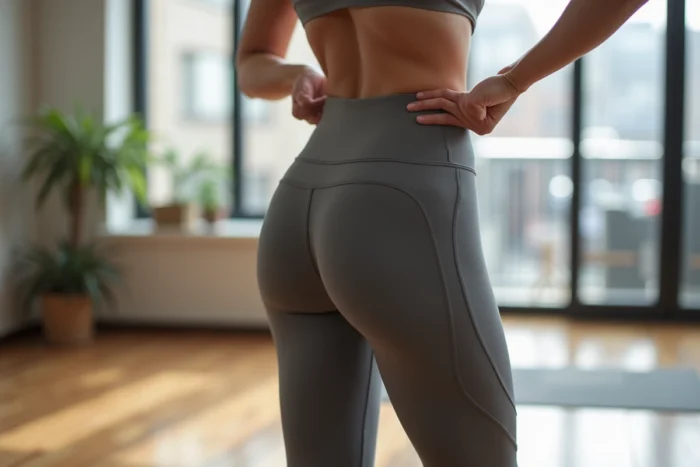
Cameltoe refers to the visible mark of the vulva under tight clothing, caused by the pressure of the fabric in the groove of the labia. The term, borrowed from English slang (literally “camel toe”), describes a purely mechanical phenomenon related to the cut of the garment, the type of fabric, and morphology.
Neither a bodily defect nor a deliberate provocation, cameltoe results from a combination of textile and anatomical factors that fashion brands are starting to treat as a real design parameter.
Sewing, gusset, weight: the textile criteria that create or prevent cameltoe
The first factor is the position of the crotch seam. A legging or short with a seam that runs exactly down the center of the vulvar area acts like a rail that guides the fabric into the anatomical fold. Several sports and athleisure brands have, since 2024-2025, shifted this seam laterally or simply removed it from the critical area.
The second element is the gusset, this piece of fabric sewn into the crotch. A wide and flat gusset that covers the entire area reduces localized tension. Conversely, a narrow or absent gusset concentrates pressure on a few centimeters of fabric, which accentuates the marking.
The third parameter is the weight of the fabric. A textile that is too thin, too elastic, or too light adheres to every contour of the body. Brands that seriously address this issue have increased the density of their fabrics and adjusted the elastane content to achieve firm support without excessive molding effect. These three criteria (seam, gusset, weight) form the technical basis to check before any purchase of tight clothing.
To understand cameltoe in women, one must first accept that the cut of the garment bears almost all the responsibility, much more than morphology.

Fast fashion and ultra-thin fabrics: why cameltoe has become commonplace
The proliferation of leggings and shorts at rock-bottom prices in fast fashion circuits has directly contributed to the frequency of the problem. These pieces use thin fabrics, with low weight, and poorly controlled elasticity. The fabric quickly deforms, thins out in the wash, and ultimately conforms to every contour of the body.
The French anti-ultra fast fashion law, definitively adopted at the end of June 2026, aims to financially penalize brands that produce massive volumes of disposable clothing. Even if this legislation does not directly target the quality of cuts, it could indirectly push some manufacturers to revise their textile specifications.
A budget legging often accumulates all the flaws: central seam not shifted, minimalist gusset, transparent fabric after a few uses. Investing in a better-constructed piece addresses the problem at its source, without needing to resort to corrective accessories.
Concrete solutions to mask cameltoe depending on the context
Responses vary depending on whether it’s sportswear, swimwear, or everyday pants. Here are the approaches that actually work.
- The thin panty liner, cited as the most effective solution by many users: it adds a thin layer of material that smooths the area without visible thickness or noise during movement, unlike a regular pad.
- Choosing a size suitable for hip measurement rather than waist measurement: a garment that is too small in hip width pulls the fabric upward and accentuates the marking, even if the waist seems correct at the belt.
- Underwear or shorts with integrated light padding, specifically designed for intense sports, which create an additional textile barrier between the body and the outer garment.
- Wearing a short or skirt over the legging, a simple solution that eliminates all visibility without altering the comfort of the base garment.
Each method has its context of use. The panty liner works everywhere. The integrated padding is suitable for sports. Layering remains the most reliable solution for a professional or formal context.
Swimwear: a special case
Swimwear poses a specific problem because you cannot layer. The fabric, often thin and wet, adheres more. Models with double lining at the bottom or with a V-cut rather than a U-cut reduce the molding effect. Checking the thickness of the lining before purchase remains the most useful action.

Embracing cameltoe: what the debate reveals about the perception of the body
On social media, some content creators claim cameltoe as a non-issue, refusing to alter their outfit to avoid a natural body contour. The argument is simple: the marking of a male torso under a tight t-shirt does not provoke any comparable reaction.
This position is not about provocation but a refusal of the additional mental burden of clothing. Adjusting one’s outfit to mask a normal anatomical shape has a cost in time, money, and comfort. The choice to embrace it depends on social, professional, and personal context, and there is no universal answer.
Some professional environments enforce dress codes that, without naming cameltoe, impose “neutral” outfits whose interpretation remains vague. The boundary between legitimate dress code and control of the female body varies by organization, without precise legal framework on this point.
Cameltoe remains primarily a textile phenomenon. A well-cut garment, with an appropriate gusset and sufficiently dense fabric, eliminates the problem effortlessly. The rest belongs to each individual’s choice, depending on the context and the level of comfort sought.