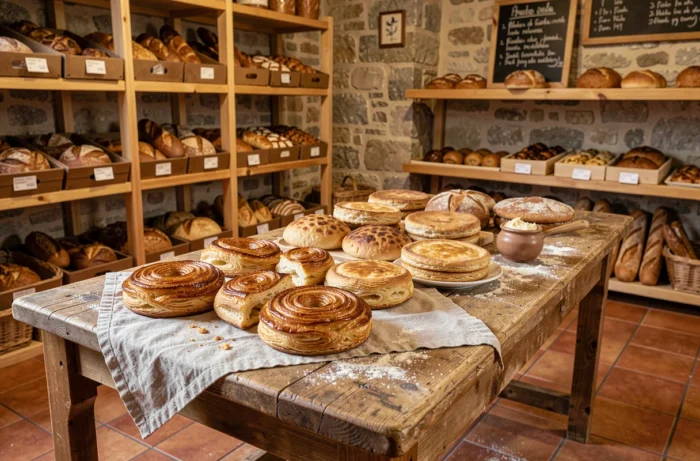
Breton pastry is based on a limited foundation of ingredients: salted butter, wheat flour, sugar, and eggs. This apparent simplicity masks precise manufacturing techniques, sometimes inherited from baking gestures of the 19th century. Understanding these specialties begins with grasping the role of salted butter in each texture and each sweet balance.
Breton salted butter: the technical link between all pastries
Salted butter distinguishes Breton pastry from almost all other French sweet traditions. Where the classic norm imposes unsalted butter to control seasoning, Breton recipes incorporate salt directly through the fat. This choice is not decorative: salt modifies the crystallization of sugar during cooking, resulting in more pronounced caramelized crusts and softer interior textures.
This peculiarity explains why a kouign-amann, a Breton cake, or a Pont-Aven biscuit share a common taste signature despite very different forms. Salted butter acts as a natural flavor enhancer that amplifies aromas without the addition of spices or flavor extracts.
To explore the must-try pastries in Brittany in detail, it is essential to keep this principle in mind: each specialty derives its personality from the quality and dosage of the farm butter used.
Kouign-amann: a bread dough turned iconic pastry
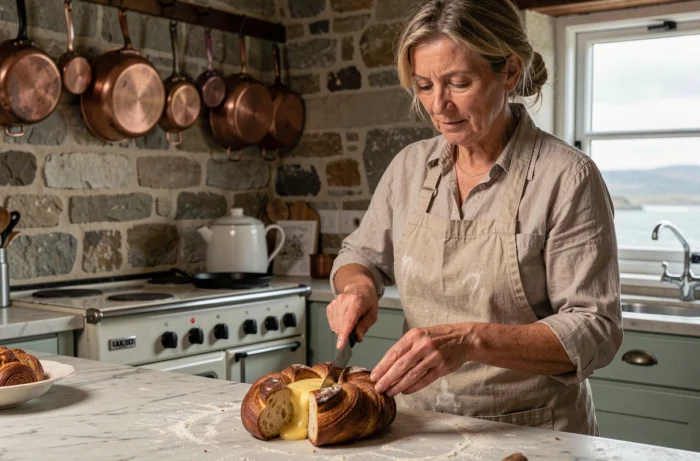
The kouign-amann (literally “butter cake” in Breton) was born in Douarnenez, in Cornwall. Its invention is traditionally attributed to Yves-René Scordia, although no dated 19th-century archive formally confirms this paternity.
Its preparation relies on a bread dough into which salted butter and sugar are incorporated through successive folds, similar to puff pastry. Success depends on two factors: the quality of the farm butter and the resting time between each fold. During baking, the butter-sugar mixture melts and caramelizes, creating a contrast between a melting heart and a crispy crust.
The kouign-amann is not protected by AOP or IGP. Therefore, any artisan can produce it under this name, which explains considerable quality variations from one bakery to another. For transport, it is best to buy it on the day of departure and keep it cool if the journey exceeds a few hours.
Far breton and gâteau breton: two contrasting textures
The far breton belongs to the family of baked flans. Its liquid batter (flour, eggs, milk, sugar) is poured into a mold and baked until it reaches a dense and slightly wobbly consistency. The addition of prunes is the most common version, but the original recipe is made plain.
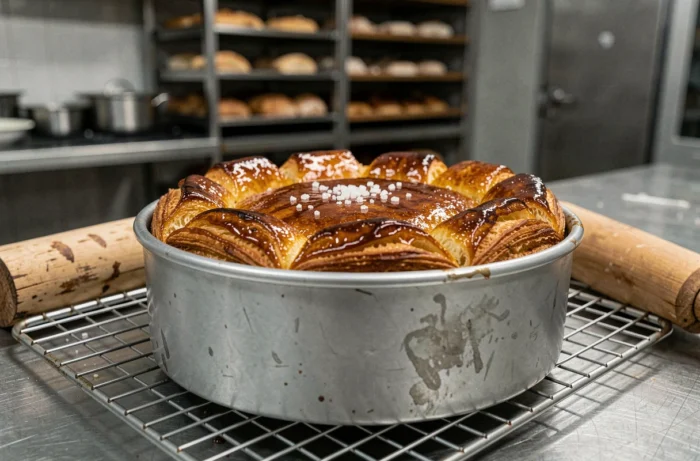
The gâteau breton, on the other hand, is closer to a thick shortbread. Its very buttery dough is worked by hand, pressed into a round mold, and then scored on the surface with a fork before baking. The result is compact, crumbly, with a pronounced salted butter flavor.
What distinguishes these two classics
- The far breton uses a liquid batter based on milk, giving it a texture similar to flan. It does not keep well beyond two days.
- The gâteau breton relies on a very high proportion of butter and contains no milk. Its crumbly texture allows it to travel more easily.
- The far is served warm or cold, often in thick slices. The gâteau breton is cut into thin slices, like a shortbread.
Craquelins de Saint-Malo: a Breton specialty off the radar
Selections of Breton pastries rarely mention craquelins de Saint-Malo. This specialty belongs to the family of échaudés: the dough is first poached in boiling water and then baked. The result is a light product, hollow inside, with a thin and brittle crust.
This double cooking (water then oven) is an ancient process that was common in French bakeries before the widespread use of convection ovens. Craquelins can be enjoyed plain, buttered, or filled in sweet or savory versions.
Their texture is closer to a table bread than a cake, but their sweet use (with jam, honey, or salted butter caramel) makes them a typical snack companion from Saint-Malo.
Salted butter caramel and candies: the sweet extension of tradition
The salted butter caramel serves as a bridge between pastry and confectionery in Brittany. It comes in the form of spreadable cream, soft candies, or as a sauce for crêpes and galettes. In Quiberon, Maison d’Armorine has been making Niniches (hand-pulled caramel lollipops) since 1946, with a family transmission spanning three generations.
This category of Breton candies forms a distinct heritage from oven pastries. It relies on a know-how of cooking sugar at precise temperatures, where salted butter is added at the end of cooking to fix the texture.
Candies to look out for during a stay in Brittany
- Niniches from Quiberon: caramel lollipops cooked and pulled by hand, available in several flavors.
- Salted butter caramel cream (like Salidou): used as a filling for crêpes or simply spread.
- Breton palets with chocolate: thick shortbread cookies, often made with Guérande salt flakes.
Breton pastry is not just a list of recipes. It reflects a relationship with salted butter that does not exist anywhere else in France. Each specialty reveals a specific manufacturing technique, from the puff pastry of the kouign-amann to the double cooking of the craquelins. Bringing back a gâteau breton or a jar of salted butter caramel means transporting an artisanal know-how that relies as much on the raw material as on the baker’s gesture.