
The dishwasher represents an often underestimated electrical expense. According to updated data from ADEME in 2025, a 12-place setting appliance used about 280 times a year consumes on average 192 kWh/year in French households. This figure exceeds the old theoretical estimates of 150 to 162 kWh/year, which were long repeated by online guides.
Understanding where this gap comes from and which levers to act upon allows for reducing the bill without completely changing one’s habits.
Why theoretical figures underestimate the actual consumption of dishwashers
The old averages of 150 to 162 kWh/year came from ADEME panels based on limited samples and cautious usage assumptions (about 166 cycles per year). The problem is that most French households run their appliance much more often.
With 280 annual cycles, or about 5 washes per week, consumption mechanically increases. Heating the water alone accounts for about 80% of the energy consumed by the appliance. The remaining 20% powers the washing arms’ motor and the drainage pump.
When trying to assess the energy consumption of a dishwasher in kWh, one must reason based on the actual number of cycles performed at home, not a dated national average.
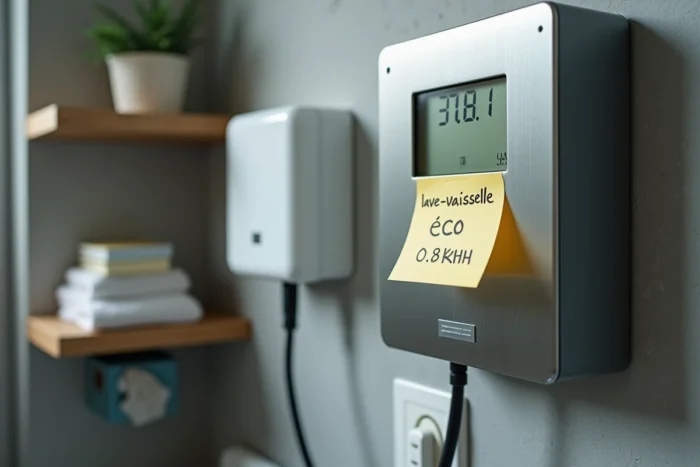
Energy label A to G: the real kWh gap between classes
The overhaul of the European energy label (transition from the old A+++ system to the A-G scale) has reshuffled the cards. Available data shows that between a modern A-rated dishwasher and a D-rated appliance, the gap exceeds 80 kWh per year based on 280 cycles.
In Eco mode, an A-rated appliance consumes about 54 kWh for 100 cycles. A D-rated model goes up to about 85 kWh for the same 100 cycles. Translated into euros, this represents a difference of about 20 euros on the annual bill at the current French residential rate.
What the label doesn’t say
The energy label displays the consumption of the Eco program, not that of the most commonly used cycles in daily life. If you regularly run an intensive or quick program, the actual consumption of your appliance will be higher than what the technical sheet promises.
Field reports vary on this point: some users find an annual consumption close to double the displayed value, simply because they never use Eco mode. The label remains a good comparison tool between models, provided that identical programs are compared.
Eco program of the dishwasher: measured reduction in kWh
The Eco program is the most direct lever to reduce a dishwasher’s consumption. Measurements on different models show a reduction of 20 to 50% in electrical consumption compared to standard cycles.
This program works by lowering the washing temperature (generally around 50 °C compared to 65 to 70 °C in normal mode). The trade-off is a longer cycle, sometimes three hours or more. The water remains in contact with the dishes longer, which compensates for the reduced temperature for cleaning.
- An Eco cycle consumes less electricity because it heats the water to a lower temperature, where most of the energy expenditure is concentrated
- The extended cycle duration does not significantly increase consumption, as the motor and pump draw little power compared to the heating element
- Over 280 annual cycles, consistently switching to Eco mode can represent savings of several tens of kWh per year depending on the model
The short cycle, a false friend
The quick cycle (30 to 45 minutes) seems economical due to its duration. In reality, it heats the water faster and hotter, which engages the heating element more intensely over a concentrated time. The consumption per cycle is often comparable, or even higher, than that of a normal program.
Water and electricity consumption: why both are linked
Reducing the water consumption of the dishwasher also reduces electricity consumption. The logic is simple: less water to heat means fewer kWh spent by the heating element.
Recent appliances consume between 6 and 10 liters per cycle depending on the chosen program. An older model can significantly exceed this range. This is a factor often overlooked in comparisons that focus solely on energy class.
- A well-filled dishwasher consumes the same amount of water as a half-empty appliance but washes twice as many dishes per kWh spent
- Regular descaling of the hydraulic circuit maintains the efficiency of the heating element, which becomes clogged and consumes more when scaled
- Connecting to hot water (when allowed by the manufacturer) reduces the workload on the internal heating element, but available data does not allow for conclusions on the net savings when hot water comes from an electric tank

Dishwasher vs. hand washing: the true balance in kWh and liters
The comparison often arises, and the data clearly favors the dishwasher for a household of more than two people. Washing by hand under an open tap consumes on average much more hot water than the 6 to 10 liters of a machine cycle.
The dishwasher consumes less water and less energy than hand washing in the vast majority of domestic configurations. The gap widens even more when compared to hand washing under running hot water, where water consumption can reach several tens of liters.
The only situation where manual washing can compete is for a very small volume (one or two plates) washed in a basin of cold water. As soon as the hot tap runs, the balance tips.
The most effective expense item to monitor remains the number of cycles. Grouping washes, filling the appliance to full capacity, and consistently favoring Eco mode are the three actions that weigh most on the annual bill, far ahead of the choice between two neighboring energy classes.