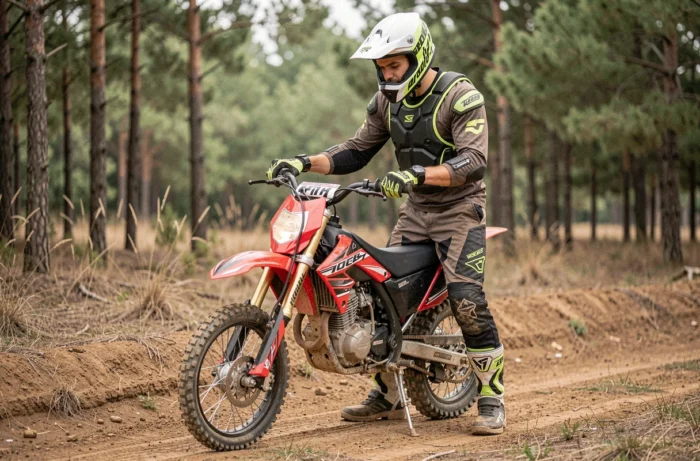
A homologated 125 cross performs just as well on a dirt path as on a departmental road. This versatility attracts many riders, but it complicates the choice: between the type of engine, weight, regulatory compliance, and maintenance budget, there are many parameters to consider. Understanding what distinguishes a track machine from a street-legal model, and then prioritizing the criteria according to your actual practice, allows you to make the right choice.
Homologated 125 cross and track 125 cross: what homologation really changes
Many beginners confuse the two categories. A track 125 cross (non-homologated) has no headlight, no turn signals, and no license plate. It is designed for competition on a closed circuit. It cannot be insured for road use.
An homologated 125 cross, classified in category L3e, comes equipped with all mandatory road equipment: lighting, mirrors, speedometer, exhaust compliant with emission standards. It receives a registration certificate and can circulate on public roads.
To delve deeper into each selection criterion, a comprehensive guide explains how to choose an homologated 125 cross based on your profile and budget.
This distinction has direct consequences on the behavior of the motorcycle. The addition of lighting, a more restrictive silencer, and road accessories increases the weight by a few kilograms. The suspensions are sometimes recalibrated to tolerate asphalt. The result: a machine that is a bit less radical but legally versatile.
Euro 5+ standard and technical inspection: two recent obligations
Since January 1, 2024, new homologated 125s must comply with the Euro 5+ standard. It imposes stricter emission tests under real conditions, an onboard diagnostic system OBD II, and monitoring of emissions over the vehicle’s lifespan. A manufacturer that fails to reconcile performance and Euro 5+ compliance produces models that are restricted or unreliable over time.
Since April 15, 2024, registered motorcycles in category L are also subject to periodic technical inspection. The schedule depends on the date of first registration. A 125 cross strictly used on the track and unregistered remains excluded, but as soon as it has a plate, it falls under the system.
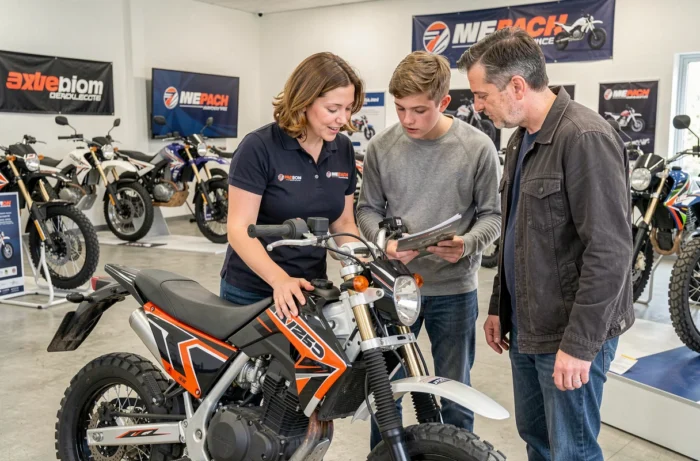
2-stroke or 4-stroke engine on an homologated 125 cross
Why does this choice matter so much? Because it determines the character of the motorcycle, its maintenance, and its cost of ownership over several years.
A 2-stroke engine delivers its power sharply and concentrated at high revs. The motorcycle is lighter and more responsive. However, the usable range is narrow: you must maintain the revs within a precise window to keep traction. On the road, this behavior becomes tiring. And the oil consumption of the mixture adds to the budget.
A 4-stroke engine offers better torque distribution across the entire rev range. The ride is more progressive and predictable. This is a clear advantage for riding on the road between off-road sessions. A 4-stroke is more forgiving of riding mistakes, making it suitable for beginner riders or those alternating surfaces.
Maintenance: very different intervals
On a 2-stroke, engine revisions (piston, ring, crankshaft bearing) occur more frequently. On a 4-stroke, regular maintenance includes oil changes, valve clearance adjustments, and air filter replacements. The intervals are generally longer, but each intervention costs more in parts.
- 2-stroke: frequent engine revisions, inexpensive parts, reduced labor time.
- 4-stroke: longer maintenance intervals, more expensive parts, greater mechanical complexity.
- In both cases, a cleaned air filter after each off-road outing extends the engine’s lifespan.
Weight, seat height, and ergonomics: adapting the motorcycle to your size
A number on a technical sheet doesn’t tell the whole story. Two motorcycles with similar weights can provide very different sensations depending on weight distribution and seat height.
Are you less than 1.70m tall? Seat height becomes a priority criterion. Being able to put at least one foot flat on the ground conditions confidence in slow maneuvers, both on the road and on a path. Some models offer lowered seats or adjustable suspension kits that allow you to lose a few centimeters without degrading the travel.
Weight directly affects maneuverability off-road. The lighter the motorcycle, the easier it is to reposition in ruts, technical climbs, and tight passages. On the road, a reduced weight translates to shorter braking distances and sharper direction changes.
Riding position and fatigue
An homologated 125 cross is often ridden standing on the footpegs off-road. The width of the handlebars, the angle of the brake and clutch levers, and the position of the footpegs: all these elements influence fatigue during a several-hour outing. Before buying, spend time in the riding position, both standing and sitting, to ensure the ergonomics match your body type.
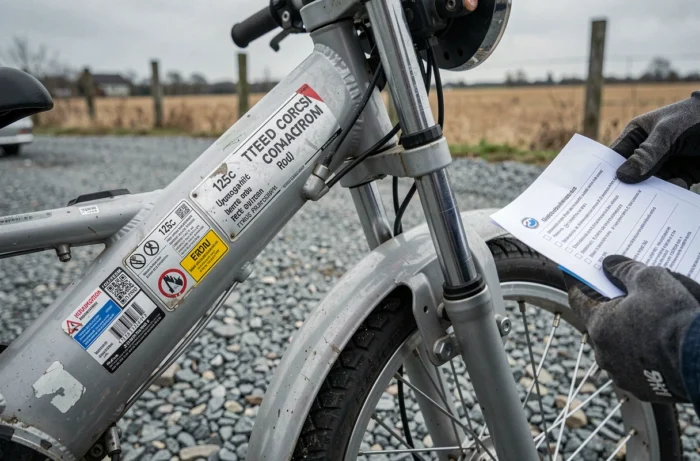
Driving license B and homologated 125 cross: the mandatory 7-hour training
In France, riding a 125 with a B license requires meeting two conditions: holding the B license for at least two years and having completed a 7-hour practical training provided by an accredited driving school. Without this training, riding on the road with an homologated 125 cross exposes you to a fine and a lack of insurance.
This training covers handling the two-wheeler, riding in urban areas, and safety maneuvers. It does not lead to an exam but results in a certificate to keep with your driving license.
- B license obtained for at least 2 years.
- 7-hour practical training at an accredited driving school.
- Training certificate to present in case of inspection.
- Holders of an A2 license: training not required.
Realistic budget for an homologated 125 cross: beyond the purchase price
The catalog price or used price represents only part of the actual budget. Insurance, maintenance, and rider equipment weigh as much as the motorcycle itself in the first year.
The insurance for a homologated 125 varies depending on the rider’s age, the length of time holding the license, and the level of coverage chosen. A comprehensive insurance policy costs significantly more than simple liability insurance but offers better protection in case of an off-road fall.
The rider’s equipment (homologated helmet, boots, gloves, chest protector, knee pads) is often an underestimated expense. Riding without appropriate off-road protection multiplies the risk of serious injury, even at low speeds on a path.
In the used market, check the condition of the steering bearings, play in the suspension links, and wear on the sprocket and chain. These parts, frequently replaced in off-road use, provide a reliable indication of past usage intensity.