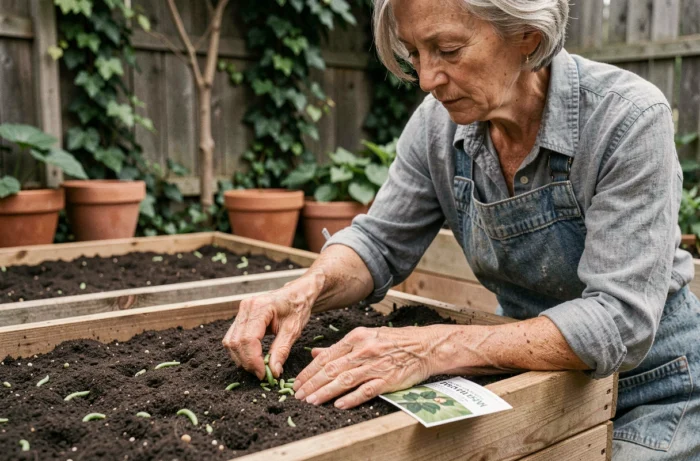
The green bean is classified as a fruit-vegetable in the biodynamic calendar, which guides the choice of sowing days towards a specific lunar category. However, this classification is not enough: the bean is also a seed sown directly in the ground, which requires crossing the position of the moon with the actual state of the soil. Understanding these two parameters before consulting a calendar prevents sowing at the wrong time, even on a theoretically favorable day.
Fruit-vegetable and seed-vegetable: this dual status complicating the lunar calendar
In the biodynamic method inherited from Maria Thun’s work, each day of the lunar cycle corresponds to a plant element: roots, leaves, flowers, or fruits. The green bean, consumed for its pod, falls under fruit days. Logic would suggest that we only sow on those days.
The problem is that the bean is also a seed-vegetable. One does not transplant a seedling: a seed is placed directly in the soil. Some practitioners believe that the germination phase is more aligned with root days, since the seed must first develop its root system before producing stems and pods.
In practice, most lunar calendars focused on gardening favor fruit days in the ascending moon for sowing green beans. The ascending moon is said to promote the rise of sap towards the aerial parts, benefiting vegetables from which we harvest the fruit. To know precisely when to sow green beans in 2026 with the moon, one must identify these fruit days during the ascending phase for each month of the sowing window.

Soil temperature in 2026: the filter that the lunar calendar does not provide
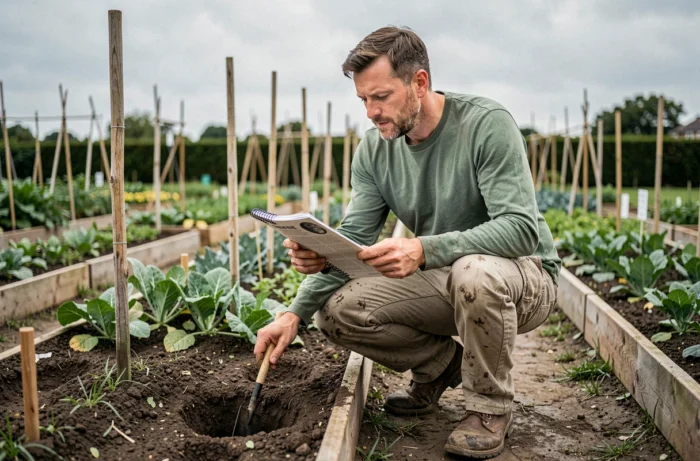
A fruit day in the ascending moon guarantees nothing if the soil is still cold. The green bean requires a soil temperature between 12 and 16 °C to be stable over several consecutive days for proper germination. Below this threshold, the seed rots before it can sprout.
This criterion shifts the actual sowing window well beyond what some lunar calendars suggest, which propose dates as early as April. In most regions of France, the soil does not reliably reach this threshold before mid-May. In semi-continental or high-altitude areas, it is often necessary to wait until late May or even early June.
Crossing the moon and thermometer according to the climatic zone
The most reliable approach is to overlay three data points: the type of lunar day (fruits), the lunar phase (ascending), and the soil temperature measured locally. A soil thermometer placed a few centimeters deep provides a direct reading, more useful than any regional average.
- Oceanic zone (Brittany, Atlantic coast): sowing possible from the second half of May if the soil exceeds 12 °C, with fruit days in the ascending moon to be prioritized
- Mediterranean zone: the window opens earlier, sometimes as early as early May, and the last sowings can extend until the end of July
- Semi-continental and mountainous zone: wait until late May or early June for the soil to warm sufficiently, which reduces the number of exploitable lunar slots
This intersection of the lunar calendar and soil temperature is the point that most generic calendars do not address, even though it directly conditions the success of germination.
Days to avoid for sowing green beans in 2026
The lunar calendar is not just about favorable days. Certain configurations make gardening inadvisable, regardless of the type of crop. Three situations recur every month and must be identified before planning a sowing.
- Lunar nodes: moments when the moon’s orbit crosses the plane of the ecliptic. Biodynamic tradition recommends not gardening during these periods, which last a few hours but which most calendars extend to the entire day as a precaution
- Perigee: the moon is at its closest point to Earth. Sowing done on these days would produce weaker and more disease-prone plants
- Apogee: the farthest point. The lunar influence would then be too weak to support germination
- Eclipses: in August 2026, a solar eclipse is reported around August 12. Eclipse days are systematically classified as unfavorable for lunar gardening
In practical terms, these exclusion days reduce the useful window of each month. Over a sowing period running from mid-May to mid-July, there are generally between two and four truly favorable slots per month, or windows of two to three consecutive days.
Late sowing window: sowing green beans after July in 2026
The question of the last possible sowing arises every summer. Dwarf green beans, which have a shorter cycle than pole varieties, can theoretically be sown until the end of July in regions where the late season remains mild. Some sources even mention sowings in early August in a Mediterranean climate.
The limiting factor is no longer the soil temperature (which is largely sufficient in summer) but the remaining time before the first autumn chills. A dwarf green bean needs 60 to 70 days between sowing and the first harvest. A sowing done on July 20 implies a harvest at the end of September, which works in the south but becomes risky north of the Loire.
For a late sowing aligned with the lunar calendar, the same rules apply: fruit days, ascending moon, absence of nodes or perigee. The difference is that the margin for error decreases. Missing the right lunar slot in July sometimes means losing the last window of the year.
The warm summer soil accelerates germination, often in less than a week. Regular watering then becomes the determining factor, more so than the lunar phase. A successful late sowing assumes a soil kept cool on the surface, especially during heat episodes that have tended to multiply in recent years.