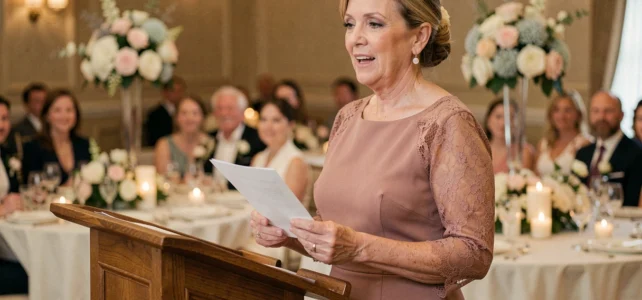
Speaking in front of an entire room about your son, the child he was and the man he has become, is a unique exercise. It is neither a toast among friends nor an intimate letter read in secret. The groom’s mother’s speech holds a special place in the ceremony: it carries the weight of an entire relationship, condensed into a few minutes.
What distinguishes a mother’s speech at a wedding
Have you ever noticed that the speeches of witnesses and those of parents do not produce the same effect? The former recount shared memories among peers. A mother’s speech touches on something older, something foundational.
The difficulty lies in achieving a precise balance. You are speaking to your son, but in front of dozens of people who do not share your story. The speech is addressed to him while including the audience. Forgetting one or the other throws everything off balance: too intimate, it makes people uncomfortable; too general, it sounds hollow.
A survey conducted by Zexy magazine among 330 parents in 2024 confirms that the speeches deemed most touching are not the most eloquent. What matters is the consistency between the words spoken and the actual relationship with the child. Ceremonial phrases take a back seat to emotional authenticity.
Writing a mother’s speech for her son’s wedding therefore requires less literary talent than personal accuracy. This is good news for those who fear they won’t find the right words.
Concrete structure of the groom’s mother’s speech
Starting from a blank page can be paralyzing. Working with a simple framework frees up your speech. Here’s a breakdown that works without sounding mechanical.
Open with a specific childhood anecdote
Not a summary of his entire childhood. One single memory, dated and sensory: the day he insisted on carrying your grocery bag at six years old, the phrase he repeated every night before sleeping, the failed cake from his first attempt in the kitchen.
This memory sets the scene and captures attention. It should be short enough to fit in three sentences, unique enough that no one else could tell it.
Name the transition to adulthood
The heart of the speech lies here. You transition from the child to the man, and it is this shift that moves people. Choose a pivotal moment: leaving for studies, a professional decision, a challenge faced together.
The goal is not to paint a comprehensive portrait. Showing in two or three sentences that you recognize the adult he has become is enough to give depth to the speech.
Welcome his partner
This part is often rushed or overplayed. Saying a few sincere words about the person joining the family, however, changes the tone of the entire speech. Mention a character trait you have observed, a shared moment, or what this person brings to your son.
Avoid generic declarations of love. A precise sentence is worth more than a vague paragraph.
Conclude with a wish for the future
No famous quotes, no proverbs found online the day before. A personal wish, expressed in your own words, grounds the speech in reality. Wish them something concrete: quiet Sundays, laughter at the table, the patience to get through tough days together.
The pitfalls that weaken a wedding ceremony speech
Some reflexes stem from good intentions but produce the opposite effect. Being aware of them before writing helps avoid regrets on the big day.
- Listing your son’s qualities like a shopping list. Three adjectives lined up without anecdotes create no emotion. Each quality mentioned benefits from being illustrated by a fact.
- Apologizing for crying or being emotional before even starting. This sets up a protective distance that prevents the speech from taking off. If tears come, they will come, and no one will hold it against you.
- Reading a text found online as is without injecting personal experience. Guests immediately hear the difference between words that are heartfelt and borrowed words.
- Exceeding three minutes. The ideal duration for a parents’ speech is between two and three minutes. Beyond that, attention wanes, even with the best content.

Finding the right tone between humor and emotion in your speech
Humor in a groom’s mother’s speech is not mandatory. But a light touch, well-balanced, prevents the speech from tipping into a solemn tone that makes everyone uncomfortable.
The most effective approach is self-deprecation. Sharing your own clumsiness in a situation related to your son works better than a prepared joke. Humor arises from the contrast with the emotion that precedes or follows it.
One funny anecdote is enough to lighten the entire speech. Two is a risk. Three, and the tone shifts towards performance, leaving no space for emotion to emerge.
The transition from humor to emotion works in one direction: start with the light, end with the sincere. The reverse (starting serious and then trying to make people laugh) creates a disconnect that is hard to recover from.
Rehearse and adjust before the wedding day
Reading your speech aloud at least three times before the ceremony changes the game. Some phrases that read well become impossible to pronounce without stumbling.
Identify the parts where your voice might tremble. Pause before these moments rather than trying to rush through them. Silence, in front of an attentive audience, carries as much weight as words.
Print the text in large font. Hold the sheet in one hand, keeping the other free. Look up regularly, especially when addressing your son or his partner directly.
The most successful speech is not the one that makes the whole room cry. It is the one where, as you fold your sheet, you know you have said exactly what you wanted to say, in your own words.