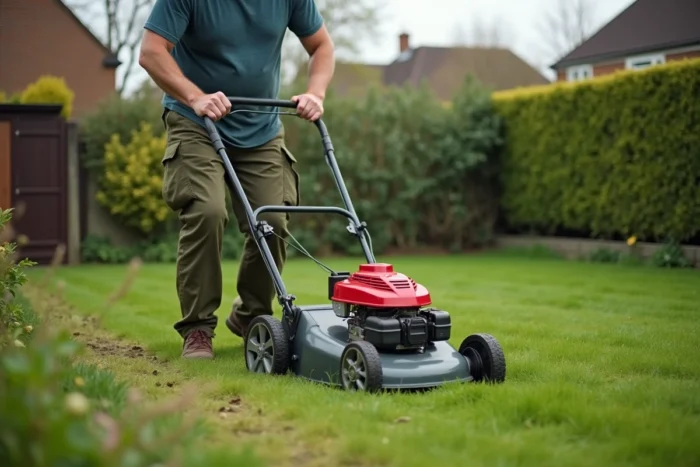
Your neighbor mows effortlessly while you push your machine to its limits in the tall grass. The difference rarely comes down to the brand or the price paid. It lies in the engine power, often poorly calibrated for the terrain.
Engine displacement and torque: what really matters in a gas mower
Competing guides talk about surface area and cutting width. They overlook a technical point that changes everything: the engine displacement and the torque it delivers to the blade.
The power of a gas engine is expressed in horsepower (hp) or watts, but it is the displacement in cm³ that determines the mower’s actual performance. A low-displacement engine running at high RPM can display similar power to a larger engine, while stalling as soon as the grass resists.
Torque, on the other hand, translates to the rotational force transmitted to the blade. The higher it is at low RPM, the more the mower can traverse dense or wet grass without slowing down. Before comparing two technical sheets, check the displacement: it will tell you more than the wattage displayed on the box.
To understand what power to choose for a gas mower, you need to look beyond the label and think in terms of engine torque relative to your actual usage.
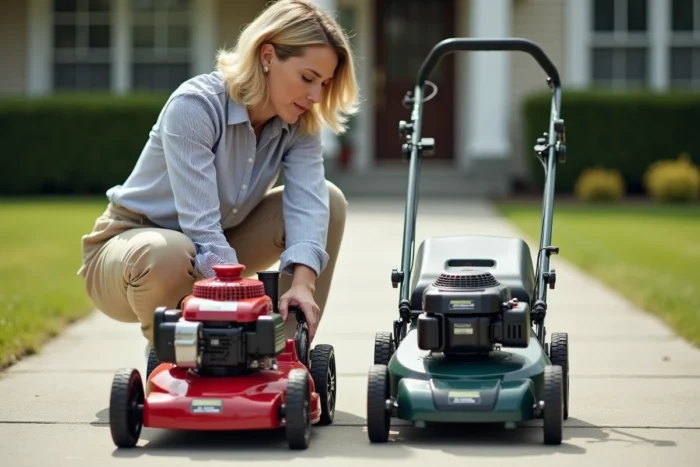
Gas mower power according to terrain type
Are you mowing a flat lawn in a subdivision or a sloped area with shaded spots where the grass grows quickly? The answer to this question radically changes the level of power needed.
Flat terrain and regular grass
On a flat surface, mowed weekly, the engine works little. A modest displacement is sufficient for regularly maintained grass. The risk of oversizing: unnecessary fuel consumption and a heavier machine to maneuver.
Sloped terrain or tall grass
As soon as the terrain rises, the engine compensates for gravity in addition to cutting. Grass that is ankle-high after two weeks without mowing requires even more torque. On this type of terrain, an undersized engine stalls, overheats, and prematurely wears out its components.
The common mistake is to choose power for the ideal case (weekly mowing, dry weather) while the machine will have to handle the worst-case scenario: returning from vacation, wet grass after rain, passages near trees.
Garden configuration and obstacles
A garden with many trees, flower beds, or corners requires constant acceleration and deceleration. An engine that is stressed by jolts wears out faster if it lacks reserve. Always plan for a power margin relative to your theoretical need.
Push mower or self-propelled: the impact on necessary power
The choice between a push mower and a self-propelled one is not just about comfort. It directly alters the useful power of the engine.
On a self-propelled mower, part of the engine’s energy drives the wheels. Therefore, less power is available for the blade. At equal displacement, a self-propelled mower cuts with less force than a push mower.
- Push mower: all the power goes to the blade, suitable for small and medium flat areas where physical effort remains acceptable.
- Self-propelled mower: essential on slopes and large areas, but requires a more powerful engine to maintain a clean cut while pulling the machine.
- Variable drive speed: some models allow you to adjust the forward speed, which preserves engine torque in difficult passages.
Ignoring this parameter means buying a self-propelled mower whose engine struggles as soon as the grass exceeds a few centimeters.
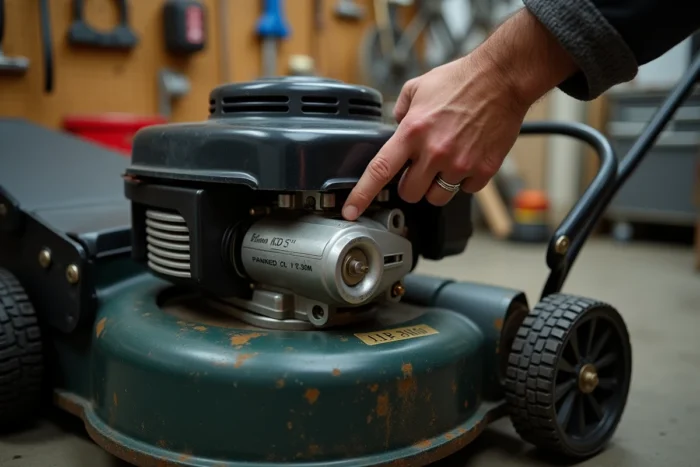
Cutting width and engine power: a balance to find
The cutting width determines the strip of grass cut with each pass. The wider it is, the more resistance the blade encounters, and the more energy the engine must provide.
You may have noticed that a wide-cut mower slows down in dense grass? This is exactly this imbalance: the width exceeds what the engine can properly support.
The cutting width must be proportional to the engine displacement. A wide blade on a small engine produces an uneven cut and strains the mechanics. Conversely, a powerful engine with a narrow cut wastes potential.
Here are the coherent associations:
- Narrow cutting width (around 40 cm): entry-level engine, suitable for small gardens.
- Medium cutting width (46 to 50 cm): mid-range engine, the most common compromise for medium surfaces.
- Wide cutting width (53 cm and more): high-displacement engine, reserved for large areas where time savings justify the investment.
Gas vs. battery: why power remains a key argument in 2026
The range of battery mowers is rapidly expanding. However, the vast majority of models sold in France remain gas-powered, especially in self-propelled and wide-cut categories.
This reality pushes manufacturers to strengthen the power of entry-level and mid-range gas models. The goal: to maintain a clear advantage over tall grass and large areas compared to electric models whose autonomy remains limited.
If your area exceeds a few hundred square meters, has slopes, or if you do not mow every week, the gas engine retains a concrete advantage in terms of sustained torque over time. The battery excels on small flat areas and frequent mowing.
The right reflex is to size the power for your worst mowing day, not for the easiest one. A well-chosen gas engine remains reliable for years without significant performance loss, provided the displacement is adapted to the actual terrain and the displayed power is not confused with the effective force transmitted to the blade.