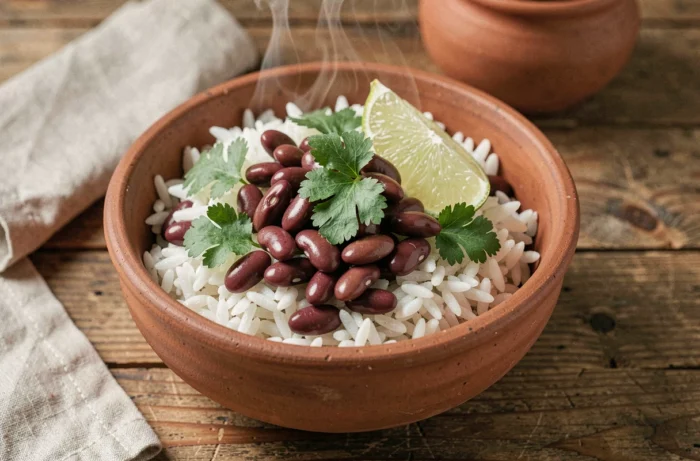
When you eat rice and red beans three nights in a row because it’s quick, nourishing, and inexpensive, the question eventually arises: can you maintain this rhythm without upsetting anything? The answer depends less on the duo itself than on how it is prepared, the variety of rice chosen, and what is placed alongside it on the plate.
Arsenic in rice: the blind spot of daily consumption
Most articles on the rice-red bean combination detail the proteins, fibers, and glycemic index. Few mention inorganic arsenic, classified as a genotoxic carcinogen, which rice naturally absorbs through its roots and concentrates in the grain.
In 2024, EFSA confirmed that chronic dietary exposure to inorganic arsenic is a public health issue. Regulation (EU) 2023/915 sets a maximum threshold of 0.25 mg/kg for husked rice (a category that includes brown rice) compared to 0.20 mg/kg for white rice. In other words, brown rice, often presented as the default healthy choice, concentrates more arsenic than white rice.
You can consult the benefits of red beans on 10 Grammes to understand the nutritional interest of the duo, but when it comes to rice, caution requires some concrete actions when consuming it almost every day.
Reducing arsenic without changing the menu
Rinsing rice thoroughly before cooking removes some of the surface arsenic. Cooking in a large volume of water (6:1 ratio) and then draining, rather than absorbing all the water, further reduces the residual content. Alternating white rice and brown rice from week to week also limits cumulative exposure.
For children, the regulatory threshold drops to 0.10 mg/kg for rice intended for infants. Varying starches remains the best protection: quinoa, bulgur, whole grain pasta, or sweet potato can replace rice on certain days without disrupting the meal’s balance.

Amino acid complementarity between rice and red beans
Rice lacks lysine. Red beans provide it abundantly but are low in methionine, which rice supplies. Combined in the same meal, they offer an amino acid profile comparable to that of an animal protein.
This complementation mechanism is well established in nutrition. In practice, you don’t even need to eat both at the same time: consuming them on the same day is enough for the body to restore the complete profile.
Concrete quantities for a balanced meal
A standard serving of legumes corresponds to 60-80 g of dry beans (before cooking), which is about 150-200 g cooked. Paired with an equivalent amount of cooked rice, you get a dish that covers a good portion of the plant protein needs of a main meal.
- Red beans are naturally rich in fiber, potassium, and non-heme iron, which enhances the nutritional density of the dish.
- Rice provides energy in the form of complex carbohydrates and complements the profile with sulfur-containing amino acids.
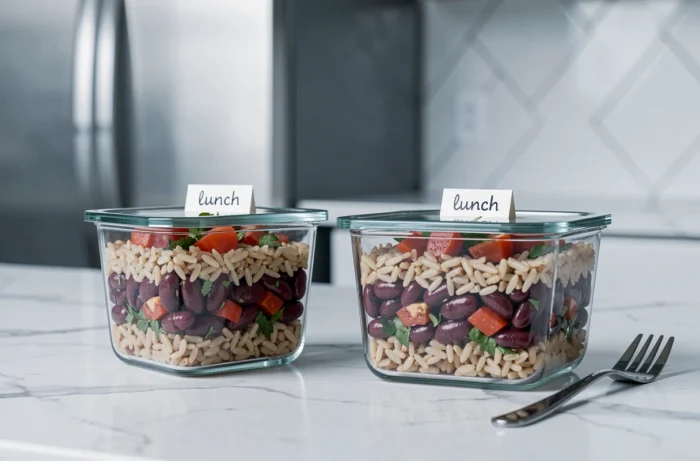
- Adding a source of vitamin C (raw bell pepper, lemon juice, tomato) improves the absorption of plant iron from the beans.
Without vitamin C on the plate, the iron from red beans remains poorly absorbed. This is a detail that changes the game when limiting animal proteins.
Realistic frequency: how many times a week to eat rice and beans
Recent nutritional syntheses aimed at the general public converge on one benchmark: legumes fit well when consumed three to four times a week by healthy adults, in a dietary model that also includes vegetables, fruits, varied grains, and quality fats.
Eating this duo every day is not dangerous in itself. The risk is not toxicological (aside from the previously mentioned arsenic in rice) but nutritional: prolonged dietary monotony eventually leads to deficiencies in nutrients absent from the duo.
What the rice-bean duo lacks
As complete as it may seem, this dish does not cover everything. Here are the main deficiencies to compensate for if consumed very often:
- Vitamin B12, completely absent from plants, requires intake through animal products or supplementation.
- Long-chain omega-3 fatty acids are not found in rice or legumes and must be supplied by fatty fish or suitable supplements.
- Calcium remains low in this duo, especially if dairy products or leafy green vegetables are not consumed in the same meal.
- The zinc in beans is partially blocked by phytates, which limits its actual absorption.
Phytates and digestive comfort: adapting the preparation of red beans
Dry red beans contain lectins (including phytohemagglutinin) that can cause nausea and digestive issues if soaking and cooking are insufficient. A soak of at least eight hours followed by boiling for about twenty minutes neutralizes these compounds.
Phytates do not completely disappear during cooking but significantly decrease with soaking. Experiences vary on this point: some people tolerate canned beans (already cooked industrially) very well, while others experience bloating even after a long home soak.
Gradually increasing portions over two to three weeks allows the microbiota to adapt. Starting with small amounts mixed with rice, then increasing, reduces discomfort.
Canned or dry beans: a practical choice that changes little in nutritional value
Canned beans have already undergone sufficient thermal treatment to eliminate lectins. Their sodium content is higher, but rinsing under running water removes a good portion. In terms of proteins, fibers, and minerals, the difference with well-cooked dry beans remains marginal.
The combination of rice and red beans works nutritionally, provided it is not made the sole pillar of one’s diet. Alternating starch sources, accompanying the dish with fresh vegetables and varied fats transforms an economical meal into a truly complete one. Three to four times a week remains the most coherent rhythm to enjoy the benefits without exposing oneself to the limits of the duo.