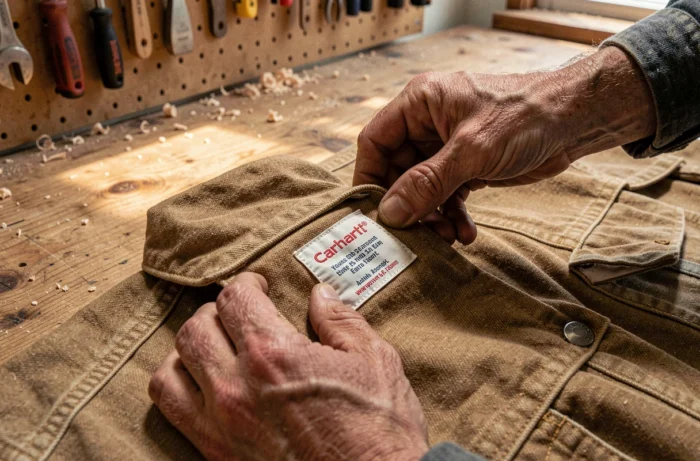
Distinguishing a genuine Carhartt from a counterfeit relies on a set of cross-checks. Counterfeiters replicate the overall appearance but accumulate errors in the manufacturing details. Five checkpoints allow for a reliable distinction: the patch, labeling, material, reference number, and the aging of the garment.
1. Check Carhartt patches and logos
The sewn patch is the first element that counterfeiters attempt to replicate, and it is where they often fail the most. On an authentic item, the spelling is always Carhartt, with two final t’s. Any variation (Carhart, Carharrt, Carthart) printed on a patch, button, or label indicates a counterfeit.
The embroidered “C” logo on recent pieces has sharp and even edges. On a counterfeit, the embroidery is often thicker, irregular, or replaced by a simple print that flakes off when washed. The metal buttons on a genuine Carhartt feature the engraving “Carhartt” in relief, never a flat print.
A less technical but useful point: before examining the patch, identify the line. Carhartt Inc. (American workwear, based in Dearborn) and Carhartt WIP (European license, streetwear-oriented) use different patches. Counterfeiters frequently mix elements from both lines on a single garment, which is a strong signal of counterfeiting. To delve deeper into these authentication criteria, the Chercher site for authentic quality details the visual specifics of each line.
2. Examine the labels and seams of a Carhartt
The inner label provides several verifiable pieces of information. On recent pieces, a holographic strip appears on the care label. Its absence on an item presented as new or recent should raise a red flag. However, on vintage pieces produced before the introduction of this strip, its absence is normal.
The label mentions a style code (style number) that corresponds to a specific model in the Carhartt catalog. This code can be cross-referenced with official product sheets to verify consistency between the cut, features, and indicated country of manufacture.
| Element | Authentic | Common Counterfeit |
|---|---|---|
| Holographic strip | Present on recent pieces | Absent or poorly reproduced |
| Style code | Matches an official product sheet | Nonexistent or inconsistent code |
| Seams | Double or triple, even | Single, irregular, loose threads |
| Label font | Sharp, consistent spacing | Blurred, variable spacing |

The seams are a reliable indicator. An authentic Carhartt uses sharp double or triple seams in high-stress areas (armholes, pockets, inseams). The threads are of uniform color, without loops or irregularities. A counterfeit often has single seams where the original garment has two or three rows.
3. Analyze the quality of Carhartt material
The fabric is likely the most difficult criterion to counterfeit. The duck and canvas fabrics used by Carhartt have a dense weight, a noticeable stiffness to the touch, and hold their shape without sagging when held by the shoulders. A counterfeit typically uses a finer, softer cotton.
The Carhartt Brown shade remains difficult to reproduce accurately. This deep ochre, characteristic of the brand, rarely turns yellow or gray on authentic pieces, even after many washes. Counterfeits often display a slightly off shade, duller or more orange.
- Zippers: the zips on authentic jackets glide smoothly and sometimes bear a manufacturer’s marking (YKK or equivalent). A zip that jams or has a lightweight slider indicates inferior quality.
- Snap buttons: they snap into place with a firm resistance. On counterfeits, the snap is soft or the button spins on its axis.
- Pocket rivets: on models that have them, the rivets are securely set and do not move under lateral pressure.
4. Check serial numbers and references of Carhartt
Each Carhartt item is associated with a model number (Model No.) printed on the inner label. This number follows a specific format, for example, TS0617-M for a Paxton sweatshirt. Comparing this number with the official product sheet remains the most reliable check.
The official sheet indicates the exact model, its description, technical features, and country of manufacture. If the number on the label does not match any existing sheet, or if the description does not coincide with the item at hand, the likelihood of counterfeiting is high.
A difference in country of manufacture alone is not sufficient to conclude a fake. Recent official sheets indicate variable origins, including “Imported” or “Made in the USA of Imported Parts.” The country listed on the label should be compared with the model and its production period.
5. Assess the wear and patina of a vintage Carhartt
In the second-hand market, the patina of an authentic Carhartt tells the story of the garment. A genuine Carhartt ages uniformly: the fabric gradually softens, creases imprint in the flex areas, and the color fades evenly in exposed areas.
An artificially aged counterfeit shows inconsistent signs of wear. The fabric may be faded at the elbows but intact at the wrists, or display visible signs of mechanical sanding under direct light. The seams of a aged fake often show a still-white thread where the fabric is supposed to have undergone years of use.
Authentic vintage pieces from the 1990s feature patches and labels specific to their production era. A recent-style patch on a garment presented as vintage constitutes a disqualifying inconsistency.
Authenticating a Carhartt relies on the intersection of these five points. No single criterion is sufficient: it is the accumulation of consistent details between the patch, label, fabric, model number, and aging that confirms the authenticity of a piece.