
Booking a flight, finding a hotel, finalizing an itinerary: these steps have become familiar. The electronic visa fits into this same logic of simplification. Instead of physically going to a consulate, mailing documents, or waiting several weeks, most procedures can now be done from a screen. The electronic visa (or e-visa) allows you to obtain an entry authorization into a foreign country by submitting a file on an official portal, without any travel.
Web form or PDF upload: two paths to the same visa
Can you imagine an interactive form to fill out box by box? This is the most common method, but it is no longer the only one. Some systems now accept the upload of a completed PDF offline, which is then directly uploaded to the portal.
In practical terms, this means you can prepare your file at your leisure, check each piece of information, and then submit the file in one operation. PDF upload is an official method in several systems, which helps travelers who are not comfortable with interactive forms.
If you are preparing your next trip and want to centralize your procedures, the online visa application on 123 Voyages gathers information by destination and by type of required document.
In both cases (web form or PDF), the principle remains the same: you submit your personal data, a scanned copy of your passport, and, depending on the country, a compliant identity photo. The response arrives by email, often within a few days.
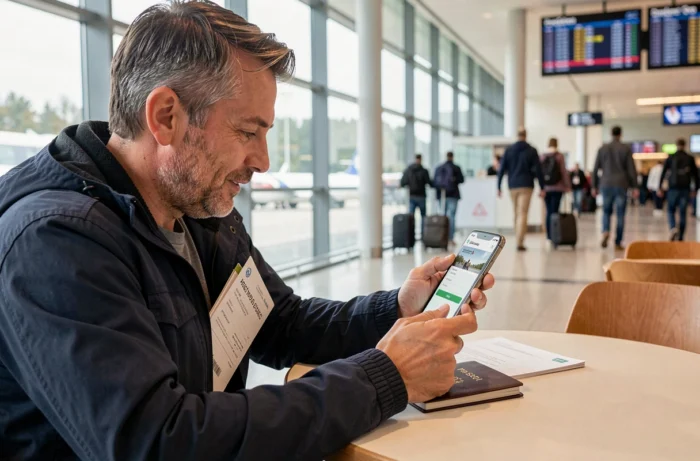
E-visa and pre-formalities: what the online application does not always cover
Obtaining an e-visa does not guarantee that all entry formalities are settled. Some countries add a distinct digital step, which should not be confused with the visa itself.
India made a digital e-Arrival Card mandatory in April 2026 for foreign arrivals and OCI holders. This card replaces the old paper form distributed on the plane. It is filled out online before boarding, in addition to the e-visa.
This duplication of digital procedures is an underlying trend. Why two steps? Because the visa allows entry into the territory, while the arrival card collects health or customs data in real-time. The two documents serve different administrations.
Anticipating the double formalities
Before considering your file complete, systematically check if the destination country requires an additional formality beyond the e-visa. Here are the points to check:
- Consult the official immigration website of the country (not just third-party aggregators) to spot any mention of an arrival card or online health form.
- Check the deadlines: some e-Arrival Cards must be submitted at least 72 hours before the flight, while others can be submitted up to boarding.
- Keep a digital copy and a printed copy of each confirmation received by email, including that of the e-visa and the arrival card.
Electronic visa and biometrics: the case of the South African ETA
The classic electronic visa relies on scanned documents. But a new model is emerging, coupling the online application with biometric verification.
South Africa officially launched its ETA in August 2026, with a gradual opening to more nationalities. The application flow includes a photo of the passport and a live biometric capture, done via a smartphone or webcam.
This system goes beyond a simple form. It links the travel authorization to a verified digital identity, which speeds up border control upon arrival. For the traveler, this means having a device with a functional camera at the time of application.
What biometrics change for the applicant
Live biometric capture adds a technical constraint. A recent smartphone with a sufficiently good camera is necessary for the system to validate the photo. A cracked screen, insufficient lighting, or an outdated browser can block the process.
Test your equipment before starting the application. Prefer a stable Wi-Fi connection and a well-lit environment, with a neutral background behind you.

Supporting documents and common errors when applying for an online visa
The rejection of an e-visa rarely relates to an eligibility criterion. In most cases, it is an input error or a non-compliant document that blocks the file.
- The passport number must exactly match the one on the scanned identity page, including any leading zeros.
- The identity photo must comply with the specifications of the country (dimensions, white or blue background, absence of glasses in some cases). A photo cropped from a selfie is almost always rejected.
- The passport expiration date must exceed six months beyond the planned entry date in most countries. A valid passport but too close to expiration results in an automatic rejection.
- Compound names or special characters (accents, hyphens) must be entered as they appear on the passport, not as you write them daily.
Review each field before submitting, as some systems do not allow modifications once a file is submitted. A new application then means starting the process over and sometimes repaying the fees.
When the e-visa is not enough: destinations without a digital portal
Not all countries have transitioned to digital. Some destinations still require a physical visa affixed to the passport, obtained at an embassy or through an authorized provider. Others, like Northern Cyprus, have only opened their e-visa to a limited number of nationalities.
Always check your eligibility by nationality before looking for an online form. An e-visa portal may exist for a given country without your passport granting access. The confusion between “the country offers an e-visa” and “I am eligible for this e-visa” remains one of the most common mistakes.
The electronic visa significantly simplifies procedures for the majority of travelers, provided you check three points before each trip: eligibility by nationality, any additional formalities, and the technical compliance of your digitized documents. These checks take a few minutes and prevent a difficult-to-recover denial at the last minute.