The iPhone does not have any ambient temperature sensor. The thermal probes integrated into current models exclusively monitor the battery and processor to prevent overheating. None of these internal measurements are exposed to the user or usable to assess the temperature of a room or a human body.
Internal thermal sensors of the iPhone: what they really measure
Apple integrates several NTC (negative temperature coefficient) probes in its iPhones. Their role is strictly related to the thermal management of the SoC and the lithium-ion cell. When the internal temperature exceeds a critical threshold, iOS triggers processor throttling or displays the alert screen “iPhone must cool down.”
These sensors do not measure the ambient air. They are positioned against the motherboard and the battery, in an environment where the heat emitted by the components skews any external reading. The internal temperature of a charging iPhone can far exceed that of the room, making any extrapolation to an ambient value technically absurd.
As explained by can the iPhone act as a thermometer according to Info Geeks, the confusion often comes from apps that claim to turn the phone into a thermometer while they do not access any sensor of that type.
Thermometer apps on iPhone: disguised weather data
Almost all “room thermometer” apps available on the App Store operate on the same principle. They query weather APIs (OpenWeatherMap, Apple Weather Kit) and display the outdoor temperature recorded by the nearest weather station to the phone’s GPS position.
The granularity of these stations covers several kilometers, sometimes more in rural areas. The displayed value corresponds to an outdoor measurement, under standardized shelter, which has nothing to do with the indoor temperature of a dwelling.
Some apps add a “correction” algorithm based on time or season. In practice, we observe that the result remains identical to the native weather widget of iOS. Paying a subscription for this same data is a form of technological placebo.
- Apps like iThermometer or Room Temperature Thermometer do not use any physical probe from the iPhone.
- The displayed values come from outdoor weather readings, not from the room where the device is located.
- User reviews on the App Store regularly confirm significant discrepancies with a real indoor thermometer.
Thermal camera and iPhone: a hardware limitation, not software
Some rugged Android smartphones (Blackview, Ulefone, Oukitel) come with a thermal camera capable of detecting very slight temperature differences on surfaces. No iPhone integrates this type of infrared sensor. The limitation is hardware: Apple has never added a thermal module to its lineup, neither in Pro models nor in standard models.
External accessories like FLIR modules connect via Lightning or USB-C and turn the iPhone into a thermal camera. These devices have their own infrared sensor and optics. The phone then serves only as a display and image processor.
The distinction is fundamental: with a FLIR accessory, the measurement comes from the external module, not from the iPhone. Without this accessory, the device remains blind to thermal infrared radiation. The iPhone’s hardware does not allow for any surface temperature measurement.
Body temperature: the function of Apple Watch, not the iPhone
Apple offers a skin temperature sensor on the Apple Watch Series 8 and later models. This sensor measures wrist temperature during sleep for menstrual cycle tracking and trend detection.
This function does not exist on the iPhone. It relies on direct contact with the skin and a dedicated sensor, two conditions that the phone does not meet. Confusing the capabilities of the watch with those of the phone is a common mistake in online searches.
Reliable alternatives for measuring temperature with an iPhone
If the goal is to obtain a reliable indoor temperature measurement via the iPhone screen, the only functional approach involves a connected external sensor.
- Connected weather stations (Netatmo, Eve Room) include a calibrated air temperature probe and transmit data to an iOS app via Bluetooth or Wi-Fi.
- Medical Bluetooth thermometers (Withings Thermo, for example) measure body temperature and sync results with Apple’s Health app.
- FLIR or Seek Thermal thermal modules add an infrared camera for surface temperature measurement, useful in maintenance or energy diagnostics.
In each case, it is the external sensor that performs the measurement. The iPhone collects, displays, and archives the data via HomeKit or a dedicated app. This architecture delegates precision to specialized hardware and uses the phone for what it does best: interfacing and processing.
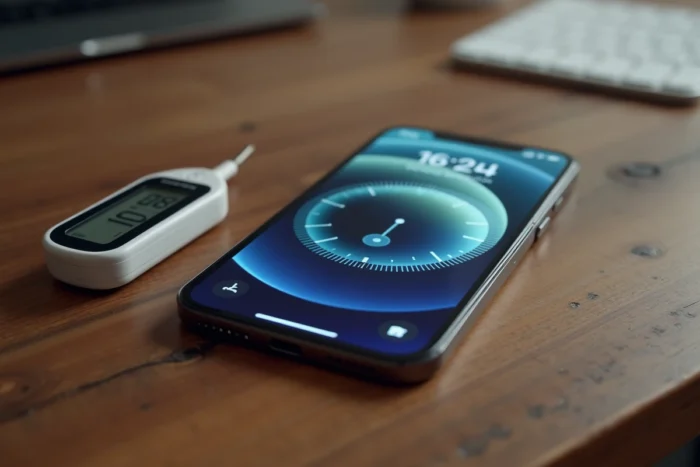
We recommend considering the iPhone as a display hub, not as a measuring instrument. Apps that claim otherwise exploit the confusion between distant weather data and local measurement. A digital thermometer costing a few euros remains more reliable than any “thermometer” app installed on the most expensive phone on the market.