L’Herbe sous le Pied is a non-profit organization established in a rural area, on the Larzac plateau, which claims a positioning as a third place combining publishing, performances, artist residencies, and collective life. Its stated ambition covers a broad spectrum: to express, experiment, share, and transmit. Behind this promise, the question of the actual usage by the local inhabitants remains open.
Rural third place and territorial anchoring: what the model implies on a daily basis
The term “third place” has become a common label to designate hybrid spaces, neither home nor workplace, intended to foster social connections. L’Herbe sous le Pied is part of this movement with a particularity: its location on a sparsely populated plateau, far from the urban centers that usually feed the attendance of such structures.
This geographical choice conditions everything. A third place in the city center effortlessly captures foot traffic. On a plateau, each visitor makes a deliberate journey. The programming must therefore justify the trip, which excludes overly niche or specialized formats.
The association highlights a place where “people meet, which they love to nurture, which they share, where they feel at home.” This wording reflects a desire to create a permanent living space rather than just a simple event venue. The information about L’Herbe sous le Pied published regularly allows for following the concrete evolution of this ambition and the activities offered throughout the seasons.
Participatory activities in rural areas: which uses find their audience
The offerings of L’Herbe sous le Pied are structured around several pillars: book publishing, live performances, exhibitions, and artist residencies. Each of these formats does not have the same potential for attraction in a rural area.
Artist residencies operate according to their own logic. They do not need a massive local audience to exist, as their value lies in the creation time offered to the artist. However, they only generate local life if times for restitution or meetings are organized with the inhabitants.
Performances and exhibitions depend more on the ability to mobilize a regular audience. On a plateau, word-of-mouth and local networks play a decisive role. Building loyalty relies on the regularity of programming and the perceived quality of each event.
Formats that struggle to establish themselves outside cities
Book publishing, the historical activity of the structure, targets an audience of readers and literary enthusiasts. This segment remains fragile in rural areas, where distribution channels are limited and where competition from online bookstores diminishes the advantage of local production.
Participatory workshops open to everyone, both children and adults, are probably the most effective lever to anchor the place in daily life. The association speaks of a space where “children and adults become Indians, aborigines, natives again,” a formulation that reflects a desire to reconnect inhabitants to their natural environment through sensory and creative practices.
Inclusive promise and reality of attendance: the tensions of a project open to all
L’Herbe sous le Pied displays maximum openness. The vocabulary used in its communication materials emphasizes welcoming all audiences, curiosity, whimsy, and the desire to learn. This promise of broad inclusion poses a targeting challenge.
A place that addresses “everyone” risks not speaking to anyone in particular. Third places that operate sustainably in rural areas often identify a pillar use (coworking, market gardening, repair café) around which secondary activities revolve. L’Herbe sous le Pied seems to bet on the opposite: multiplying entry points without prioritizing.
Some rural cultural third places manage to create a loyal community thanks to the uniqueness of their programming, while others struggle to go beyond the circle of founders and their close ones. Viability often depends on very concrete factors:
- The frequency of public events, which must be sufficient to create a habit without exhausting volunteers
- The ability to integrate everyday uses (associative café, basket pickup point, shared workspace) in addition to cultural activities
- The support of local authorities, which often conditions access to suitable premises and operational grants
The association has chosen to define itself also by an ecological dimension, which further broadens the spectrum of potential audiences. The articulation between ecology and culture remains the crux of the project, as these two axes do not always mobilize the same people or networks.
Nature, culture, and local life: positioning against other third places
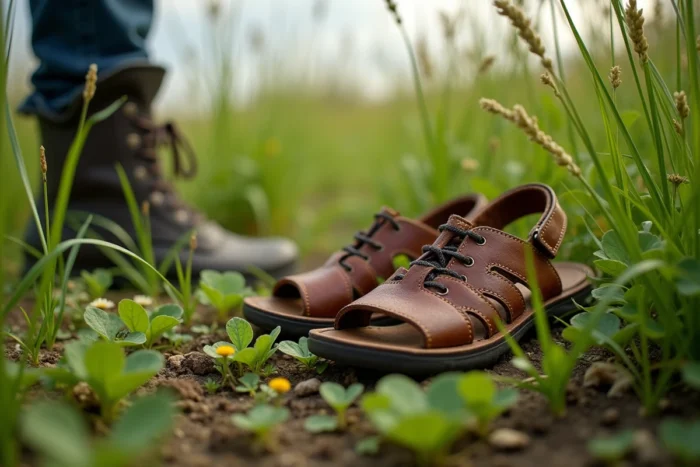
L’Herbe sous le Pied stands out for a philosophy that refuses the separation between nature and culture. The association asserts that “nature ceases to be this external place created to justify the supremacy of humans over all other living beings.” This philosophical positioning places it within a specific current of thought, that of relational ecology, which has been influencing part of the rural associative world for several years.
In practice, this orientation translates into activities that combine nature outings, outdoor artistic creations, and collective reflections on the relationship with the living. This intersection between nature and artistic creation defines the identity of the place and differentiates it from purely cultural or purely environmental spaces.
The question of sustainability remains. A rural associative third place relies on the energy of a few people, and the turnover of volunteers can quickly undermine a functioning project. The available data does not allow for assessing the financial health of the structure or its actual level of attendance.
Follow the news of the place
The association primarily communicates through its website and social media. For a place located in a sparsely populated area, digital communication compensates for the lack of urban visibility. Events are announced as they come up, which requires interested inhabitants to stay regularly informed.
The model of L’Herbe sous le Pied illustrates a tension present in many rural projects in France: the desire to create a shared living space clashes with the constraints of a territory where population density mechanically limits the number of participants. On the Larzac plateau, the regularity of programming and the ability to integrate everyday uses will remain the most reliable indicators of the real anchoring of the place.