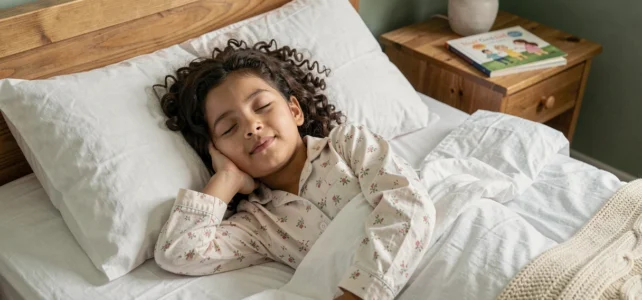
Children’s sleep has become one of the most common reasons for pediatric consultations, with a noticeable upward trend since the pandemic. Measuring the gaps between recommended sleep durations and actual observed durations helps understand why this issue goes beyond mere nighttime comfort. Several international organizations have harmonized their recommendations in recent years, providing a clear framework to assess children’s sleep quality by age group.
Recommended sleep durations by age: the WHO and AASM framework
The World Health Organization (WHO) and the American Academy of Sleep Medicine (AASM) have reaffirmed and harmonized their recommendations on sleep duration by age group. This data serves as a reference for pediatricians and families.
| Age group | Recommended duration (per 24 hours) |
|---|---|
| Infant (4-12 months) | 12 to 16 hours (including naps) |
| Toddler (1-2 years) | 11 to 14 hours (including naps) |
| Preschool child (3-5 years) | 10 to 13 hours |
| School-age child (6-12 years) | 9 to 12 hours |
| Teenager (13-18 years) | 8 to 10 hours |
The gap between these ranges and the reality observed in the general population is the central issue. Since the pandemic, the disorganization of rhythms (remote schooling, decreased physical activity, increased screen time) has widened this gap for a significant proportion of children.
An article detailing the importance of good sleep for children reminds us that each age group has distinct physiological needs, and ignoring them compromises overall development.
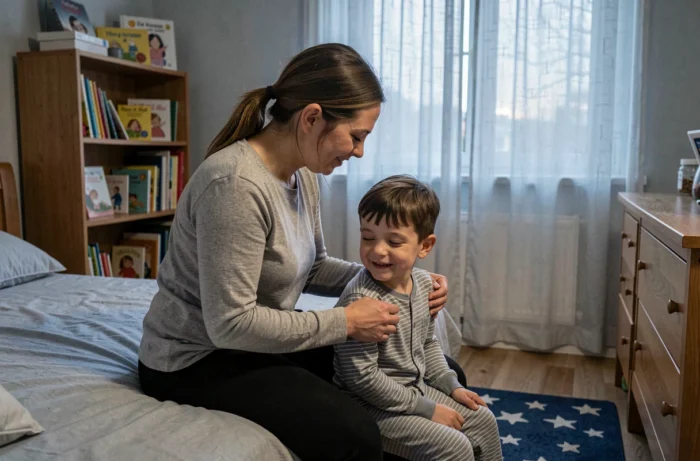
Screens before bedtime: a measurable factor of sleep debt
Competitors mention screens as a sleep disruptor. What needs to be clarified is the concrete mechanism by which they act and the extent of the phenomenon post-pandemic.
The blue light from screens delays the secretion of melatonin, the hormone that triggers sleep onset. In children, this delay is more pronounced than in adults because the lens is more transparent and allows more short-wavelength light to pass through.
The problem is not limited to light. The content consumed (short videos, interactive games, social media) causes cognitive and emotional activation that prolongs the wake phase. Several post-pandemic surveys show that evening screen use has notably increased among children, alongside a rise in difficulties falling asleep and nighttime awakenings.
What behaviors to observe
- A child who regularly takes more than thirty minutes to fall asleep after the lights go out, especially if they were exposed to a screen in the previous hour
- Frequent nighttime awakenings without identified medical causes, often correlated with high screen time during the day
- Persistent morning fatigue despite an apparently correct bedtime, indicating that sleep quality is impaired even if the duration seems sufficient
Removing screens at least one hour before bedtime remains the most documented measure to reduce sleep onset delay in children.
Sleep and brain development: what happens during the night
Deep sleep (or slow-wave sleep) is the phase during which the brain consolidates the day’s learning. In children, this phase represents a larger proportion of the sleep cycle than in adults. Deep sleep is also when growth hormone is primarily secreted.
Conversely, REM sleep plays a role in the maturation of the nervous system and emotional regulation. It is during this phase that the brain sorts, categorizes, and integrates experiences from the day. A child who sleeps poorly accumulates a deficit on both fronts simultaneously.
Memory, attention, and emotional regulation
Available data show a direct link between sleep debt and difficulties in academic learning. A child lacking sleep experiences decreased attention span, deteriorating working memory, and a lower frustration threshold.
These effects are not limited to cases of severe deprivation. Even a modest but chronic reduction in sleep duration, on the order of half an hour to an hour per night over several weeks, produces measurable effects on cognitive performance and classroom behavior.
Sleep disorders in children: spotting the line between habit and pathology
Not all sleep problems require the same management. Sleep disorders are now among the most common reasons for pediatric consultations. Distinguishing a poor ritual from a structural disorder changes everything.
A child who resists bedtime because the routine is inconsistent (variable schedules, excitement before bed, lack of clear signals) falls under behavioral adjustment. A child who experiences frequent nighttime awakenings, sleepwalking, recurrent night terrors, or regular snoring requires medical advice.
- Parasomnias (night terrors, sleepwalking) are common in children aged 3 to 8 years and do not always require treatment, but should be reported to the pediatrician if they disrupt overall sleep
- Obstructive sleep apnea syndrome, often related to enlarged tonsils or adenoids, affects a significant fraction of children and often goes unnoticed
- Children with neurodevelopmental disorders are particularly vulnerable to sleep problems, which can in turn exacerbate daytime symptoms
An untreated sleep disorder in a child can mimic or amplify an attention disorder. This diagnostic confusion is documented and justifies a sleep evaluation before drawing any conclusions about daytime behavior.
The quality of children’s sleep is not just a matter of bedtime. It involves hormonal, cognitive, and emotional mechanisms whose effects accumulate night after night. The gap between international recommendations and the daily reality of many families, exacerbated by the omnipresence of screens and the aftermath of the pandemic on life rhythms, remains the main lever to act upon.